Restaurant owners open their monthly P&L reports, check the sales and then move down to the bottom of the report and close the report.
Does this sound familiar?
If only those two numbers are examined then the real value is not realized.
They shouldn’t be more dependent on a accounting firm. They should be more confident in their own numbers. You don’t have to know all accounting rules or be a slave to invoices for hours. It’s essential to know the reason for the fluctuation in profits and what transpired with the use of labor and food, and which questions need to be addressed next week.
Bookkeeping Chef is a computer program which automatizes bookkeeping, so the owners can focus in other activities while receiving more precise financial reports.
Don’t stop at Month-End Numbers. Start with the Weekly Numbers
A monthly P&L matters, but restaurants aren’t operating monthly. The managers plan the work for the week. Chef has ordered food. Vendors change prices now.
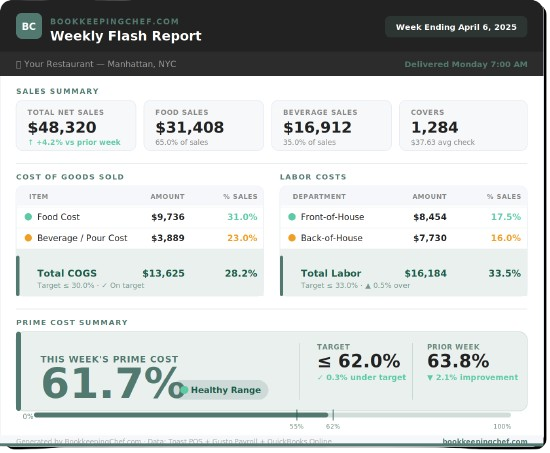
That’s why Bookkeeping Chef provides weekly prime-cost flash reports along with monthly financial statements.
Prime cost includes costs of selling goods and labor, two areas that are able to move quickly in a restaurant. The information supplied by the Bookkeeping Chef shows that the prime cost typically accounts for 60 percent of sales in restaurants.
Think about a situation where sales aren’t even changing, but prime costs are rising. The percentage alone does not offer the answer. The owner has an excuse to do some investigation.
Was there an increase in hours was worked? Did overtime occur? Did food costs change? Did vendor invoices seem excessively high? Has the mix of sales changed?
It’s far more beneficial than identifying the same issue two weeks later.
Automate repetitive tasks
DIY bookkeeping does not need to be done manually by transferring POS (point of sale) amounts onto spreadsheets.
Automating restaurant bookkeeping can help to reduce the number of times financial data is moved. The service is able to integrate systems like POS as well as QuickBooks payroll vendor platforms and inventory management.
Automating just for the sake of automated is not the aim.
The goal is to eradicate manually entering data and to ensure that financial records are kept up-to date so that the owners are able to spend more time reviewing the data rather than assembling it.
This creates a new model of bookkeeping for restaurants. The software takes care of more of the mechanical aspects, but the owner remains involved in the financial aspects.
Learn to ask the P&L More Questions
A P&L can be a lot less intimidating when you stop treating it like an accounting exam.
Start with the sales. Next, look at the costs of production. Compare the performance of food and beverages. Look at labor. Reduce operating expenses and see what remains.
In addition, it is important to compare timeframes.
If profits increased but sales grew, but profit wasn’t, something else between those two lines was changed. What happened when food prices were rising? Review the staffing numbers and sales activities in case labor percentages have changed. If you notice a strange number, investigate rather than assuming that the restaurant had poor month.
Bookkeeping Chef will send monthly P&Ls that are completed in five business days. This gives owners the opportunity to look over recent performance, not receiving financial statements after the operating time has ended.
For owners searching bookkeeping restaurant solutions, speed is useful but understanding is the bigger objective.
It’s not required to make everything.
There’s a middle way between outsourcing the entire financial functions to someone else and establishing yourself as your own full-time bookkeeper.
Owners are still able to participate in the process of accounting without needing to complete every task by hand.
This may mean the use of automated systems to keep track of information flow, reviewing the monthly P&L and a weekly report on prime costs or asking questions when an unexpected event occurs.
Specialized bookkeeping for restaurants can help in this way by keeping the books in order and helping the restaurant owner know what they are.
It is unlikely to end up with one who can carry out all the functions.
Owners who can sit down and talk intelligently about their company with the P&L will have more success.
The Objective Is Financial Independence, Not More Reports
Restaurants already generate massive quantities of data. A different dashboard might not be beneficial.
When an operator can take a look at their weekly prime cost report and notice that something has changed, they are able to then access their P&L to determine what requires more investigation.
Bookkeeping Chef’s approach to bookkeeping combines restaurant accounting automation, weekly reports, monthly P&Ls as well as the provision of financial support for specific restaurants to make this possible.
Automate repetitive tasks. Examine your prime cost each week. Learn to speak the same language as your P&L.
There is no need to be a professional accountant.
You should be a successful owner who knows the financial story behind your restaurant.